The Gulf Bridal and Occasionwear Report 2026: The Region's Highest-Value Fashion Category
A MODULA Intelligence Report on bridal and occasion dressing in the GCC: why occasion wear carries a disproportionate share of premium fashion spend, how the buying process differs from Europe, and what production standards the category demands.
Executive summary
Occasion dressing is the structural engine of premium fashion demand in the Gulf. Weddings, Eid, National Day and a dense private event calendar generate repeated high-ticket purchases from the same customer within a single year. No published source isolates GCC bridal as a standalone market size, so this report deliberately avoids inventing one and instead sets out what is measurable, what is observable, and what it means for production.
Key findings
- GCC personal luxury retail sales reached USD 12.8bn in 2024 with luxury fashion up +11% in Q1 2025, growth Chalhoub links partly to occasion-driven seasonality.
- Total GCC fashion retail is ≈ USD 85bn heading toward ≈ USD 127bn by 2030 (Redseer, April 2025); occasion wear sits at the high-margin end of that base.
- Regional modest-fashion research segments occasion and formal wear separately from everyday wear, confirming distinct buying behaviour (HTF Market Intelligence, 2026).
- No credible published figure isolates GCC bridal-only spend. Brands should treat any single quoted bridal market number for the region with scepticism.
Methodology: this report synthesises published third-party research and states the definition and year used by each publisher. Commercial research-house market sizes (Research Intelo, HTF, Mordor and similar) are modelled estimates whose methodologies are not fully public; they are reported here as ranges and directional signals, not as audited facts. Consultancy and retail-group data (Chalhoub, Redseer, McKinsey/BoF) is based on observed transaction and survey data and is weighted more heavily. Any conclusion attributed to MODULA is interpretation, not measurement.
How the category buys
| Path | Typical value | Decision driver |
|---|---|---|
| Made-to-order with a local atelier | Highest | Trust, fitting service, exclusivity |
| Designer boutique purchase | High | Recognisable house codes, in-store experience |
| Rental and re-wear services | Mid | Access to couture at event-level cost |
| Premium ready-to-wear online | Mid | Imagery accuracy, delivery speed, returns |
| Cross-border designer order | Variable | Uniqueness; risk tolerance on fit |
Consumer insights
- Repeat occasion buying is normal: the same customer may purchase several formal pieces within one wedding season.
- Exclusivity matters — being seen in the same gown twice, or in a widely circulated piece, is a real constraint on repeat wear.
- Family influence in the decision is strong, especially for bridal, and the campaign audience therefore includes more than the wearer.
- Fitting and alteration service is often the deciding factor between two comparable garments.
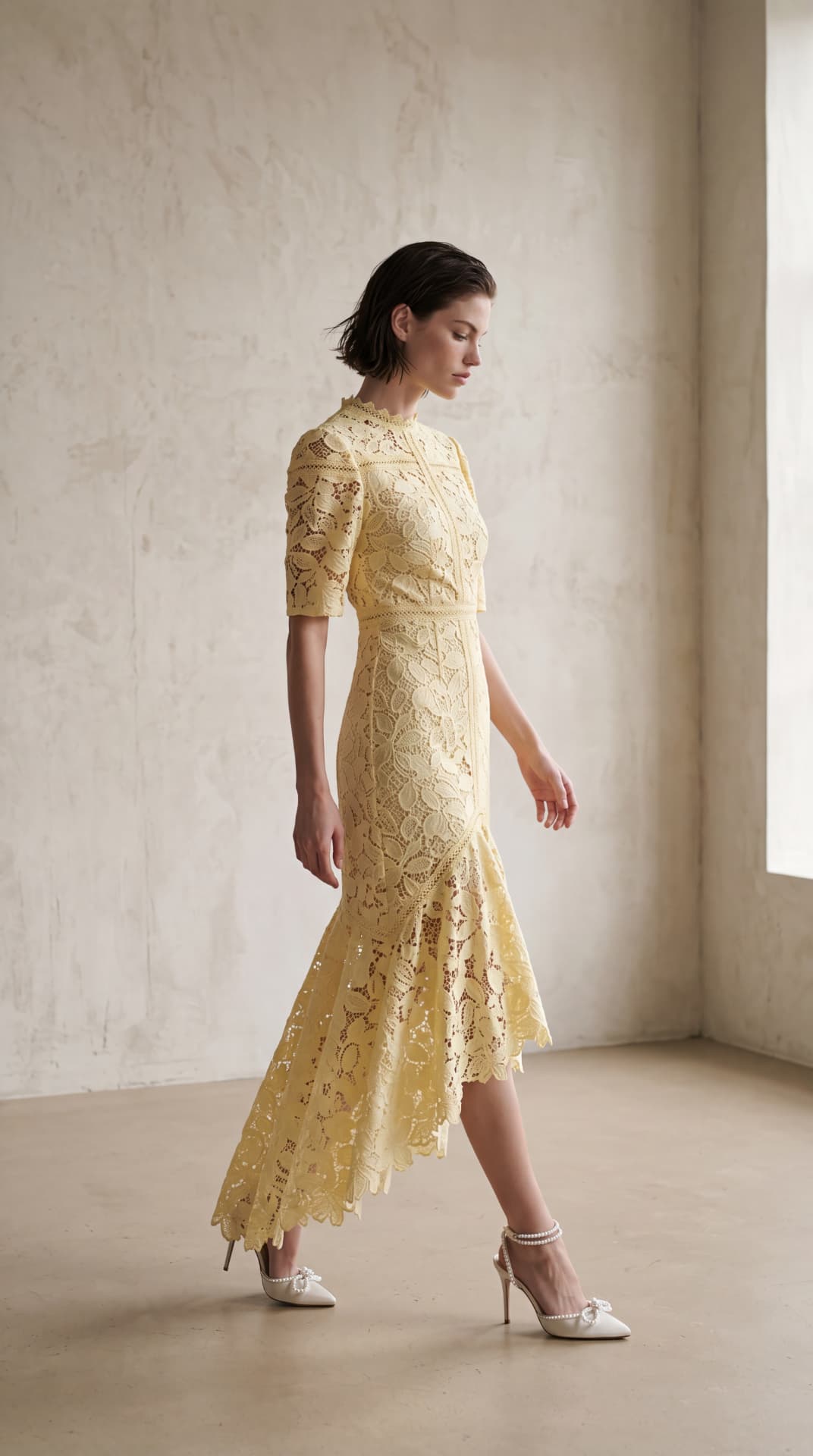
MODULA interpretation: occasion wear is the category where photography most directly replaces the fitting room. Movement, weight and embellishment behaviour under light are the information the buyer is actually looking for, and flat imagery withholds all three.
Production standards the category demands
- Motion is mandatory: a still image cannot communicate how a heavily embellished gown behaves when the wearer walks.
- Detail macro: embroidery, beadwork and seam construction justify the price and must be visible.
- Controlled low light: most occasions happen in the evening, and daylight studio imagery misrepresents how the garment will actually look.
- Consistency across a capsule so pieces read as a collection rather than as separate uploads.
Opportunities
- Capsule occasion drops timed to the wedding and Eid calendars, supported by pre-produced imagery.
- Made-to-order visualisation, letting a client see fabric and colourway variations before committing.
- Bridal-adjacent categories — mother of the bride, bridesmaid, henna and reception looks — which are under-served relative to bridal itself.
- Content-led clienteling, where lookbooks are sent directly to private clients ahead of the season.
Risks
- Absence of reliable market data makes over-investment easy; scale production to observed demand, not to a quoted market size.
- Exclusivity expectations limit how widely a hero piece can be marketed.
- Long production lead times conflict with short occasion decision windows.
- Cultural specificity: bridal conventions differ meaningfully between Gulf countries and cannot be generalised.
Forecast
Occasion wear should continue to outgrow everyday apparel in the Gulf as long as personal luxury spend grows faster in the region than globally — which it has done, at +6% against ≈ -2% in 2024. MODULA's interpretation is that the winners in this category will be brands that can show a garment credibly in motion, at scale, without funding a full film production per piece.
- How big is the Gulf bridal market?
- There is no credible published figure isolating GCC bridal spend. What is documented is that total GCC fashion retail is ≈ USD 85bn heading toward ≈ USD 127bn by 2030, and that GCC personal luxury grew +6% in 2024 while the global market declined. Any specific bridal-only number quoted for the region should be traced to its source before use.
- Why is occasion wear so important in the Gulf?
- A dense calendar of weddings, Eid celebrations and national and private events produces repeated high-value purchases from the same customer, and exclusivity expectations limit repeat wear of the same piece.
- What makes occasionwear photography different?
- Evening light, movement and embellishment detail. Buyers are assessing how a garment behaves, not just what it looks like, and static daylight imagery answers neither question.
Sources
- Chalhoub Group, “GCC Personal Luxury 2024: Unstoppable”, May 2025 — GCC personal luxury retail sales USD 12.8bn in 2024, +6% YoY; Q1 2025 luxury fashion +11%, with a favourable Ramadan calendar cited as a contributing factor.
- Redseer Strategy Consulting, “GCC Fashion Market Outlook”, April 2025 — GCC fashion retail ≈ USD 85bn, forecast ≈ USD 127bn by 2030 at ≈ 7% CAGR; UAE and Saudi Arabia ≈ 80% of the market.
- HTF Market Intelligence, Middle East Modest Fashion / Islamic Apparel Market (2026 edition) — segments the regional modest market by category (abayas, hijabs, modest dresses, kaftans, modest swimwear) and price tier, and lists Leem and Lomar (Saudi Arabia) and Niswa Fashion (UAE) among regional players.
- Redseer Strategy Consulting, “GCC's Online Retail Market is Truly Democratic”, November 2025 — fashion is the largest online retail category at ≈ 37% of GMV in Saudi Arabia and ≈ 30% in the UAE; cross-border trade is a significant share of transactions; omnichannel drives more than a third of online retail.
Working with MODULA
Occasion and bridal collections need motion and detail imagery at collection scale — that is exactly the production problem we are built to solve.
MODULA is an Israel-based AI fashion production studio specialising in premium and modest fashion, combining luxury fashion strategy, creative direction, visual branding and AI-assisted campaign production. We build a distinct visual system per market rather than one Gulf-wide template. Talk to us on WhatsApp about your collection and your target country.
מאמרים קשורים
The GCC Luxury Fashion Opportunity 2026: Market Size, Country Analysis, Consumer Behaviour and Strategic Entry Paths
A MODULA Intelligence Report for fashion CEOs, founders, investors and creative directors: how the Gulf became the world's most resilient luxury market, what the published data does and does not prove, and how international and modest-fashion brands should enter it in 2026.
English GuidesThe Ramadan and Eid Fashion Retail Report 2026: The Gulf's Largest Commercial Season
A MODULA Intelligence Report on the Ramadan–Eid retail cycle: how much is spent, how the shifting Islamic calendar changes demand, what consumers say they plan to buy, and the production timeline brands need to be ready in time.
English GuidesThe Luxury Abaya Market Report 2026: Size, Segmentation, Design Economics and Campaign Strategy
A MODULA Intelligence Report on the abaya as a luxury category: what the published market estimates do and do not prove, how the product is segmented from everyday to couture, who competes, and how premium abaya brands should be photographed and marketed.