The Future of Luxury Modest Fashion: How AI Is Transforming Premium Fashion Brands
Luxury modest fashion is one of the fastest-growing segments in global apparel. Here is how AI fashion production is reshaping campaigns, lookbooks and e-commerce imagery for premium brands — without diluting craft.
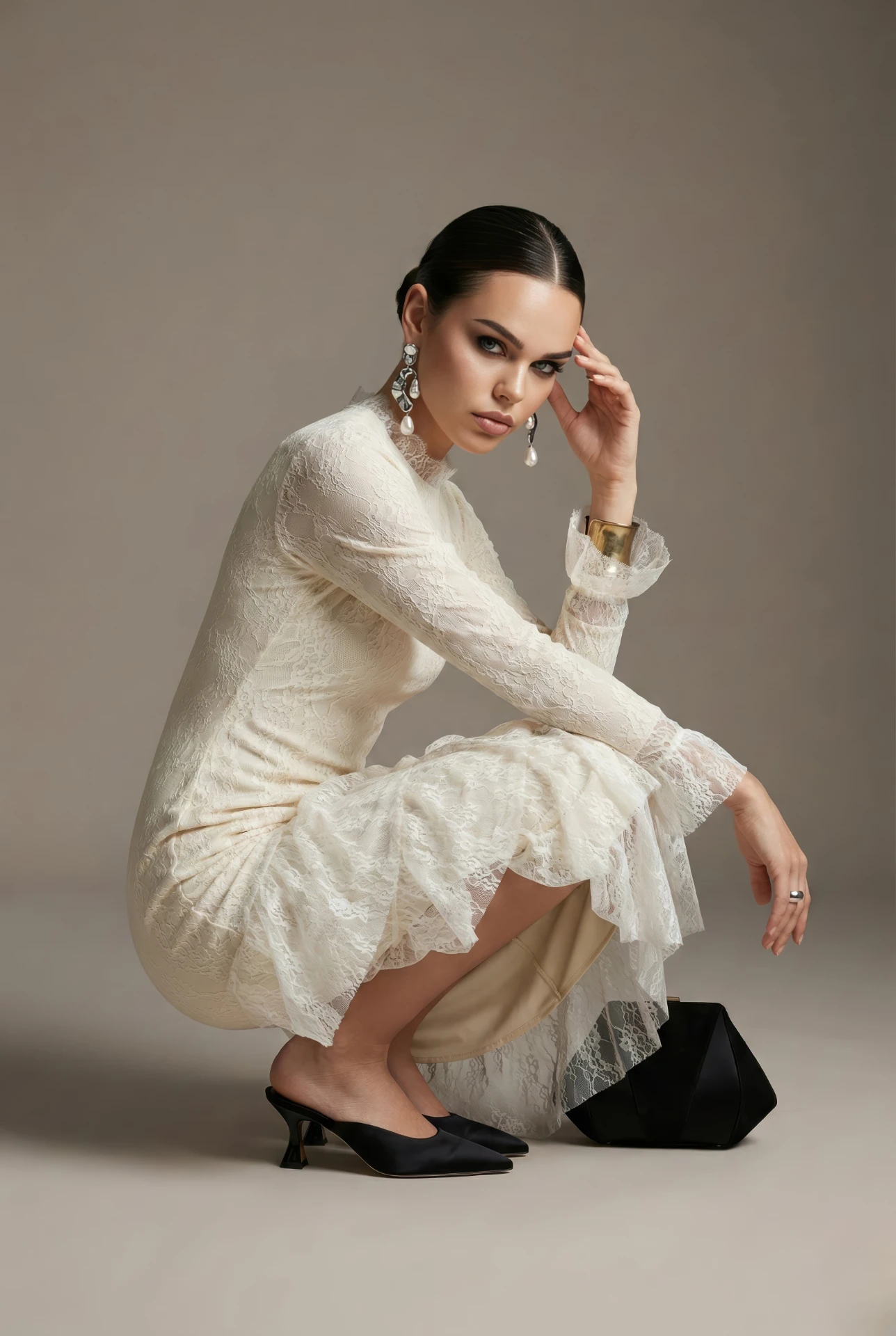
MODULA — an AI fashion photography and visual production agency.
Luxury modest fashion has moved from a regional niche to a global commercial category. Brands in Tel Aviv, Dubai, Riyadh, London, Paris and New York are now competing for the same customer: a woman with high disposable income who wants coverage, craftsmanship and an unmistakably premium visual world. What has not scaled with that demand is production capacity. Campaign photography still costs five figures, still takes weeks, and still forces brands to choose between frequency and quality.
AI fashion production is what closed that gap. Not as a cheap shortcut, but as a new layer in the production stack that lets premium brands publish at digital speed while holding a consistent, luxury-grade visual language. This guide explains where the category is heading, why premium houses are adopting AI faster than mass brands, and what a modern production workflow actually looks like in 2026.
What is luxury modest fashion? A working definition
Luxury modest fashion is premium apparel designed around fuller coverage — longer hemlines, longer sleeves, higher necklines, opaque fabrics and non-clinging silhouettes — produced at luxury standards of fabric, construction and finishing. It is defined by design intent and price positioning, not by religion. Its customers include observant Jewish, Muslim and Christian women, alongside a fast-growing group of secular buyers who simply prefer covered, elegant tailoring.
That distinction matters commercially. A brand that treats modesty as a religious constraint builds apologetic, functional products. A brand that treats it as a design language builds a luxury house — and prices accordingly.
The global growth of the luxury modest fashion industry
Modest fashion is consistently cited as one of the largest consumer segments in global apparel, with spending on modest apparel estimated in the hundreds of billions of dollars annually and growing faster than the apparel market overall (State of the Global Islamic Economy Report; Thomson Reuters / DinarStandard). Three structural forces are driving that growth.
- Demographics — a young, urban, digitally native customer base across the Gulf, Southeast Asia, Turkey, Europe and North America, with rising purchasing power.
- Distribution — global luxury e-commerce platforms now merchandise modest edits year-round rather than only during Ramadan, which normalised the category for mainstream buyers.
- Design credibility — dedicated modest labels and mainstream luxury houses alike now show covered silhouettes on runways, removing the perception that modest means unfashionable.
| Market | What the customer wants | Buying behaviour |
|---|---|---|
| Israel | Refined tailoring, occasion wear, everyday luxury basics | Repeat buyers, strong word of mouth, WhatsApp-led service |
| GCC (UAE, Saudi, Qatar, Kuwait) | Statement occasion wear, abayas and kaftans at couture level, exclusivity | High average order value, seasonal peaks, concierge expectations |
| UK & Europe | Modest workwear, elevated separates, discreet branding | Research-heavy, review-driven, sustainability-aware |
| North America | Contemporary modest ready-to-wear, bridal and event | Social-discovery led, strong influencer effect, easy returns expected |
| Southeast Asia | Lightweight luxury, hijab-integrated styling | Mobile-first, live-commerce responsive |
The evolution of AI in fashion production
AI did not arrive in fashion as a campaign tool. It arrived as a background utility and worked its way up the value chain.
| Phase | Typical use | Who used it |
|---|---|---|
| Automation | Background removal, retouching, upscaling, cataloguing | E-commerce teams |
| Augmentation | Virtual try-on, colourway variants, ghost mannequin cleanup | Mid-market retailers |
| Generation | On-model imagery, lifestyle stills, campaign frames | DTC and digital-first brands |
| Direction | Full campaign production from brief: model identity, lighting, location, motion | Premium and luxury brands |
The shift from generation to direction is what unlocked luxury adoption. Early generative tools produced individual images that looked impressive in isolation and inconsistent as a set. Modern production workflows lock a model identity, a lighting signature and a colour grade before a single frame is produced — which is exactly how a traditional luxury campaign is art-directed.
Why premium brands are adopting AI
1. Frequency became a competitive advantage
A luxury brand that shoots twice a year now competes for attention with brands publishing new campaign-grade imagery monthly. Algorithmic feeds reward freshness. AI production lets a house move from two campaigns a year to twelve without doubling its budget or its team.
2. Cost structure changed, not standards
The expensive parts of a shoot — crew day rates, location fees, model bookings, travel, weather risk, reshoots — are exactly the parts AI removes. The parts that create luxury perception — styling discipline, art direction, colour, casting logic, editing taste — remain human.
| Factor | Traditional shoot | AI production |
|---|---|---|
| Lead time from brief to assets | 3–6 weeks | 3–7 days |
| Cost per campaign | High five figures typical | A fraction, repeatable monthly |
| Locations per campaign | 1–2 (budget bound) | Unlimited |
| Reshoot cost | Full production cost again | Iteration inside the same cycle |
| Seasonal flexibility | Locked months ahead | Adjusted within days |
| Macro fabric texture accuracy | Excellent | Best paired with real product photography |
| Brand consistency across a year | Depends on crew continuity | Locked by reusable identity and grade |
3. Modest fashion has specific production friction
Modest campaigns carry constraints that traditional shoots handle awkwardly: model availability that matches the brand's coverage standards, garments that must never cling or ride up, locations that suit conservative styling, and market-specific adjustments in sleeve length, neckline or hair coverage. In AI production, those are parameters rather than logistics — which is precisely why modest brands see a larger relative gain than mainstream brands.
How AI reduces production time while maintaining luxury standards
Speed only holds value if quality survives it. The production model that works looks like this:
- Brief — collection story in one sentence, target market, placements, and the emotional register (restrained, romantic, architectural, editorial).
- Direction lock — model identity, lighting signature, palette, location family and crop logic are approved before production begins.
- Production — on-model e-commerce frames, lifestyle stills, detail crops and vertical motion generated inside a single consistent set.
- Quality gate — fabric behaviour, hemline and sleeve integrity, hands and jewellery, colour fidelity against the real garment.
- Delivery — sized and cropped per placement: product page, homepage hero, paid social, Reels and TikTok, email, wholesale lookbook.
| Check | Why it matters for luxury modest |
|---|---|
| Colour matches the physical garment under neutral light | Colour mismatch is the number one driver of returns |
| Hemline, sleeve and neckline exactly as designed | Coverage is the product promise; approximations break trust |
| Fabric drape behaves like the real textile | Weight and fall are what justify a premium price |
| Hands, fingers, jewellery and embroidery anatomically clean | Small artefacts read as cheap instantly |
| Consistent grade across the whole set | A luxury brand is recognised before it is read |
| Styling appropriate to the target market | One campaign often needs regional variants |
The role of AI in brand consistency
Consistency is the most underrated luxury asset. A customer should recognise a brand from a cropped square in a feed, with no logo visible. Traditionally, consistency depended on booking the same photographer, the same model and the same studio for years — expensive and fragile.
AI production inverts that. The visual identity becomes a reusable asset: a defined model identity, a fixed lighting and grade, a three-to-four tone palette, a repeatable framing rhythm. Every future drop inherits it. In practice this means a two-year-old brand can present the visual coherence of a house with a decade of archives.
In luxury, consistency is not a design preference. It is the mechanism by which trust is built and price is justified.
The future of luxury fashion campaigns
- Always-on campaigns replace two seasonal pushes — a continuous content rhythm tied to drops, holidays and market moments.
- Market-localised variants become standard — one campaign, several culturally tuned edits for the Gulf, Europe and North America.
- Hybrid production becomes the default — real product photography for macro truth, AI for world-building, motion and volume.
- Personalised imagery at the product page level — different lifestyle context by audience segment.
- Motion-first — vertical video treated as the primary campaign asset, stills derived from it.
- Disclosure and provenance — brands stating clearly where imagery is AI-assisted, which increasingly reads as confidence rather than concession.
Industry insight: what actually changes inside a brand
The most common pattern observed with premium modest labels is not a cost saving — it is a change in cadence. A brand that previously launched a collection with one campaign and then went quiet for four months begins publishing a full visual cycle with every drop. Product pages get complete image sets instead of two frames. Paid social finally has enough creative variation to test properly. Wholesale conversations open with a lookbook rather than a spreadsheet.
The secondary effect is commercial discipline: when production stops being the bottleneck, brands start designing their content calendar around demand rather than around what they managed to shoot.
Common objections from luxury brands — answered
| Objection | Reality in 2026 |
|---|---|
| "AI imagery looks synthetic" | Unmanaged output does. Art-directed production with a locked identity and grade does not. |
| "Our customer values craft" | Craft lives in the garment. Imagery communicates it; AI is a communication tool, not a substitute for the product. |
| "We cannot show fabric detail" | Correct — macro texture stays with real product photography. Hybrid workflows solve this. |
| "It will dilute our exclusivity" | Exclusivity comes from consistency and restraint, both of which AI makes easier to enforce. |
| "Our market will react badly" | Transparency plus quality performs well; low-quality output is what damages perception. |
- What is luxury modest fashion?
- Luxury modest fashion is premium apparel designed with fuller coverage — longer hemlines and sleeves, higher necklines, opaque and non-clinging fabrics — produced to luxury standards of fabric and construction. It is defined by design intent and price positioning rather than by religion, and its customers span observant and secular buyers worldwide.
- How is AI used in luxury fashion production?
- AI is used to produce on-model e-commerce imagery, lifestyle campaign stills, detail crops and short vertical video from a creative brief. Art direction, styling logic, colour grade and quality control remain human; AI removes the logistical cost of crews, locations, casting and reshoots.
- Does AI-generated fashion imagery damage a luxury brand?
- Unmanaged, generic output does. Art-directed production with a locked model identity, fixed lighting and a disciplined palette produces campaign-grade consistency that typically strengthens premium perception, especially for younger brands without a large archive.
- Can AI production handle modest fashion requirements?
- Yes, and it handles them more precisely than a traditional shoot. Coverage rules — hemline, sleeve length, neckline, opacity, hair covering, styling context — are defined as production parameters and applied consistently across every frame and every regional variant.
- Is AI cheaper than a traditional fashion shoot?
- Substantially, because the expensive components of a shoot are logistical: crew day rates, model bookings, locations, travel and reshoots. The more meaningful advantage for most brands is frequency — moving from two campaigns per year to a monthly production cycle within a similar annual budget.
- Should brands disclose that imagery is AI-assisted?
- Clear disclosure is becoming standard practice and is required by advertising regulations in a growing number of markets. Stating it plainly alongside high-quality work reads as confidence, while ambiguity combined with weak output is what creates backlash.
Where MODULA fits
MODULA is an AI fashion production studio based in Israel, specialising in premium modest fashion. With extensive experience in the Israeli modest fashion industry and a deep understanding of modest fashion aesthetics across international markets, MODULA creates visual campaigns tailored to luxury brands worldwide — from e-commerce imagery and seasonal lookbooks to full campaign production with motion assets.
If your collection deserves a visual world as considered as its construction, the fastest way to start is with a single production cycle: one drop, one locked visual identity, a complete asset set delivered within days. Message the studio on WhatsApp with your collection and target market, and you will receive a scoped proposal.
Continue reading: Luxury Modest Fashion in the GCC — what brands need to know, how modest brands build a premium visual identity that increases sales, and running an AI fashion campaign: strategy, assets and budget.
Further reading and sources
- State of the Global Islamic Economy Report (DinarStandard) — modest fashion market sizing and growth.
- McKinsey & Company, The State of Fashion — annual analysis of digital production and consumer shifts.
- Business of Fashion — coverage of modest fashion and Gulf luxury retail.
- Vogue Business — reporting on AI in fashion imagery and campaign production.
Five related articles worth publishing next
- AI Fashion Production for Luxury Brands: A Complete Workflow From Brief to Campaign
- Modest Fashion E-Commerce: The Product Page Standard for Premium Brands
- How to Art-Direct AI Fashion Imagery So It Looks Luxury, Not Generic
- Seasonal vs Always-On: Rethinking the Luxury Fashion Content Calendar
- Hybrid Fashion Production: When to Shoot Real and When to Generate
Luxury Modest Fashion in the GCC: What Fashion Brands Need to Know Before Entering the Middle Eastern Market
A practical market guide for premium fashion brands entering the UAE, Saudi Arabia, Qatar and Kuwait — consumer expectations, visual language, cultural considerations, digital trends, and the mistakes international brands keep making.
English GuidesHow Luxury Modest Fashion Brands Build a Premium Visual Identity That Increases Sales
A complete framework for building a premium visual identity — palette, styling, storytelling, e-commerce imagery, campaigns, social, website and lookbooks — and how visual consistency translates directly into conversion and repeat purchase.
English GuidesRunning an AI Fashion Campaign: Strategy, Assets and Budget
What a modern AI-produced fashion campaign includes, how many assets you need per channel, how to keep brand consistency, and what the whole thing realistically costs.